Patterns of Accumulation in Linked Progressive Systems Yielding Life Changing Sums for Occasional Participants
Drew Fischer · Jun 30, 2026

Patterns of Accumulation in Linked Progressive Systems Yielding Life Changing Sums for Occasional Participants
Linked progressive systems operate through networks of gaming machines that pool contributions from each wager into a shared jackpot pool, and this structure creates accumulation patterns where the prize grows steadily until a qualifying win occurs. Data from multiple regulated markets shows that these systems often reach substantial totals because contributions arrive from numerous locations simultaneously rather than from isolated units.
Researchers have tracked how the rate of accumulation depends on factors including the number of connected machines, the percentage of each bet allocated to the progressive pool, and the frequency of play across participating venues. In systems with hundreds or thousands of linked terminals the jackpot meter advances more rapidly, while smaller networks exhibit slower but still consistent growth until a trigger event resets the pool to its seed amount.
Mechanics Behind Accumulation Rates
Each participating machine deducts a fixed portion of every wager and routes that amount to a central server that manages the shared meter, and observers note this centralized tracking allows precise monitoring of growth trajectories over time. Studies of operational data indicate that average daily increases vary by jurisdiction yet commonly range from several thousand to tens of thousands of dollars once a network exceeds a few hundred terminals.
Reset values and increment percentages are programmed in advance, which means the starting point after each payout influences how quickly the next cycle begins, while the increment rate determines how steeply the meter climbs between hits. Operators adjust these parameters to balance player appeal against payout liability, and records from gaming authorities demonstrate that such calibrations produce predictable long-term accumulation curves.
Participation Patterns Among Occasional Players
Transaction logs from linked progressive networks reveal that a meaningful share of top-tier payouts goes to individuals who play infrequently rather than to daily regulars, and this distribution arises because random number generators governing the jackpot trigger do not favor any particular playing schedule. Occasional participants therefore encounter the same mathematical probability per spin as more frequent visitors once they sit at an eligible machine.
Figures compiled by industry research groups show that many record-setting wins have occurred during single visits or short trips, which underscores that sustained engagement is not required for a qualifying combination to appear. Systems continue to accumulate regardless of who places the bets, so the pool grows steadily between infrequent sessions just as it does during periods of heavy use.
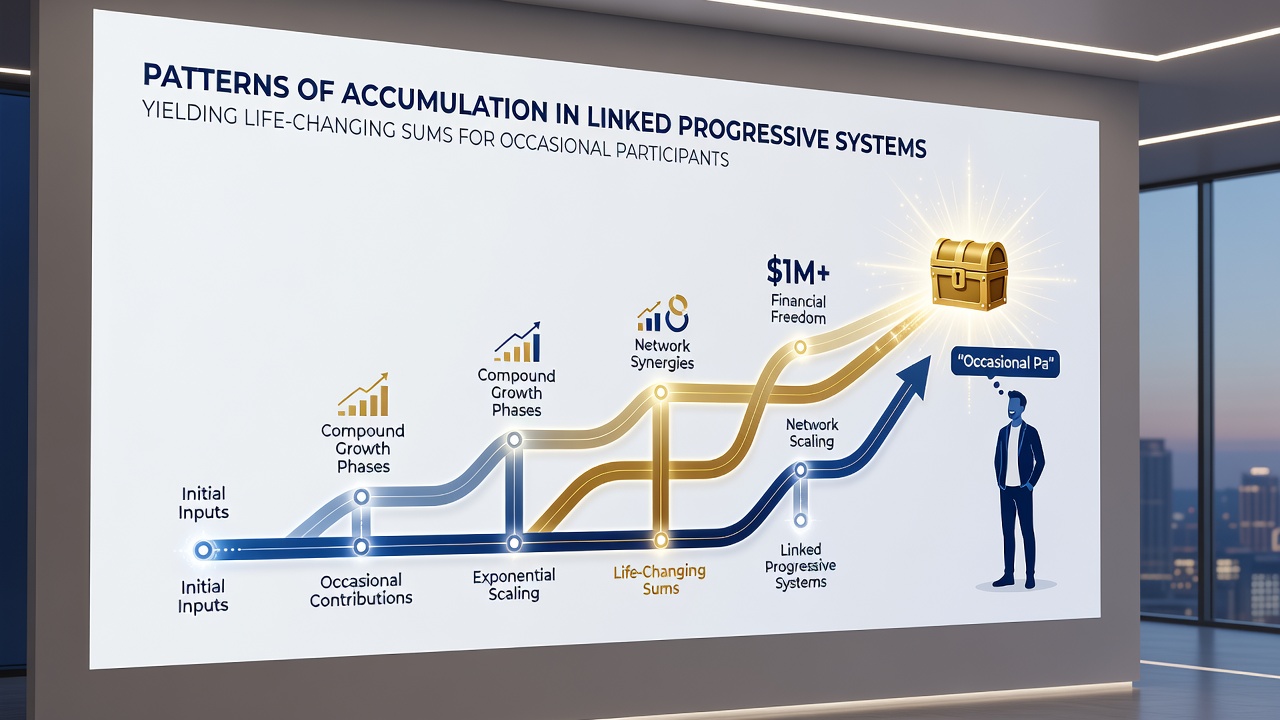
Regional Data and Growth Trends Through Mid-2026
Regulatory filings from North American and European markets indicate continued expansion of linked progressive networks during the first half of 2026, with new installations adding thousands of additional terminals to existing pools each quarter. As of June 2026 several multi-state systems in the United States reported meter values exceeding previous annual peaks, driven by both increased machine counts and steady wager volumes.
According to statistics released by the Canadian Gaming Association, cross-provincial linked progressives in Canada posted average monthly growth rates above historical norms through spring 2026, while parallel networks in Australia maintained comparable trajectories under oversight from state gaming commissions. These parallel developments illustrate how geographic expansion and technological interconnection amplify accumulation speed across continents.
Documented Cycles and Reset Behaviors
Analysis of payout histories demonstrates that most linked progressives follow cycles beginning at a predetermined seed amount and climbing until a randomly selected trigger combination appears, after which the process restarts. The length of each cycle varies widely because the trigger mechanism relies on probability rather than fixed intervals, yet aggregate data across thousands of cycles produces reliable averages for expected time between hits.
Operators publish historical hit frequencies for individual games, and those published ranges allow observers to calculate rough projections for accumulation duration under given machine counts. Because the underlying mathematics remain constant, occasional participants face identical cycle dynamics whether they play once a month or once a year.
Conclusion
Patterns of accumulation in linked progressive systems continue to generate substantial jackpots through pooled contributions across wide machine networks, and records confirm that occasional participants receive a measurable portion of teh largest payouts. Data from regulatory bodies and industry associations document steady growth rates and reset behaviors that remain consistent regardless of individual playing frequency. As networks expand into additional jurisdictions through 2026, the same structural dynamics are expected to sustain large prize pools for future cycles.